This small note is an introduction to Topology that follows the introductory arguments of (Armstrong 2013).
Euler's Theorem
We will start our journey in topology following a classical example in the history of Mathematics the relation:
Valid for classical Polyhedrons.
Basic definitions
Polyhedron
It's a collection of plane polygons (see Programmazione lineare#Poliedro) such that:
- Every polygon shares each of its edges with exactly another polygon
- We have vertexes that can be shared by many polygons. Informally we have a piece of surface with a vertex.
Theorem statement
If we have a Polygon such that
- Any two vertices of are connected through a path in the edges. (connected principle)
- Any loop on made of its vertices made of straight line segments (we don't need to pass through the edges) separates in two pieces. (informally if we cut there then the surface does not separate completely). Then we have , where are the number of vertices, the number of edges and the number of faces.
The two conditions above are justified by the counter example observations:
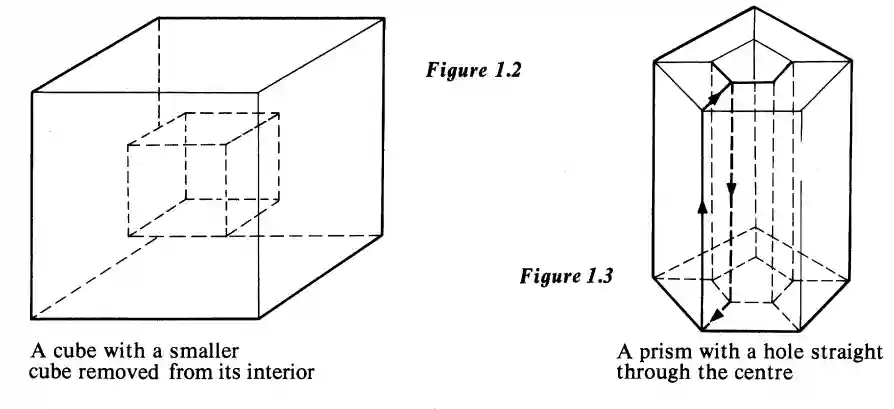 .
Which clearly do not follow the theorem
.
Which clearly do not follow the theorem
Simple proof
Here, I will just sketch the general proof (there will be some interesting observation, but that is left for later). We know that vertices + edges are just a graph, and for every graph there is a easy way to find a tree with all of the graph nodes. By a property of the trees, we know that every tree has , easily provable with induction on the number of nodes. The we construct some sort of a dual tree which we call built in this way.
- Vertices are random points on every face of
- Two vertices are connected if their corresponding faces share an edge, and this edge does not belong to . It can be proven that is indeed a tree, thanks to the 2 initial hypothesis, and then we know that
The beautiful observation about this proof, is that every polygon that satisfies those hypothesis can be divided in two parts, which imply it is topologically equivalent to split a sphere (this is why it's 2!)
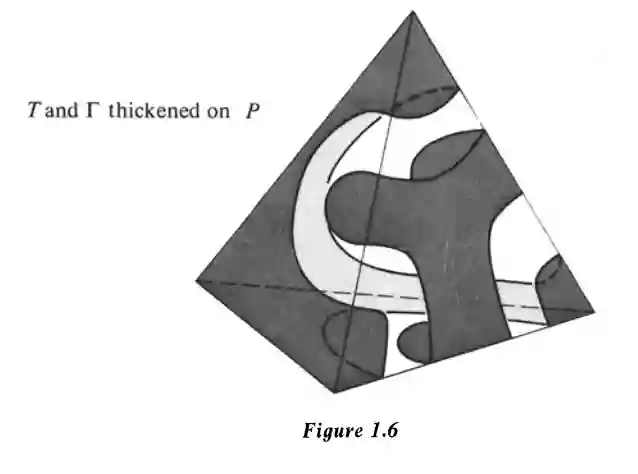 Which means that it is just a deformed sphere from the faces point of view.
Legendre's Proof
Before we can understand this proof, we need to understand how to calculate the area of a spherical polygon which is just a polygon mapped to the surface of a unit sphere.
Spherical Polygon Area
Lemma: given angles and edges then the area of the spherical polygon is
This value is known as the excess in spherical geometry, and one can prove that the area is equal to where is the radius of the sphere. This is also known as Girard's theorem.
Proof: If you have Girard's theorem (advised to check the link for a visualization), useful for simple triangles, then it's easy to recompose everything and have that theorem, in this case we will just prove Girard's theorem:
Consider a Spherical Lune, it's easy to see that it's area, given an angle , is given by this proportion
If we sum all the lunes of a triangle, we have the area of the entire sphere and three times our triangle. Let's all the area of the triangle, we have (because we count the antipodal triangle, and use lunes to cover the entire sphere):
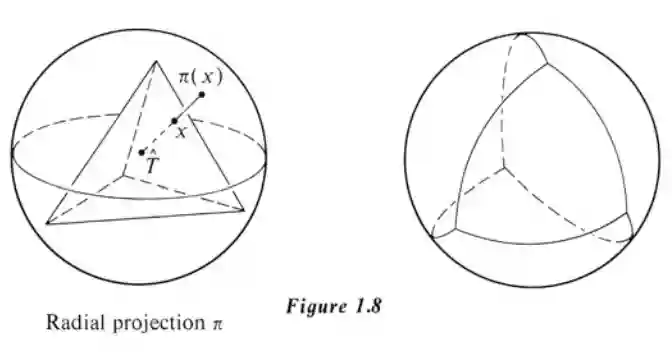
The proof
So now we know that a specific spherical polygon's area is We now sum over all the polygons and we obtain where is the number of vertices, of edges and faces, that is the number of polygons. This is true because every vertex at the end is counted as in radians, and every edge is counted twice, and we are summing polygons so we have the last term. Simplifying the we obtain which is the Euler's theorem. This is a nice proof, and quite easy after you know the Spherical Polygon area lemma.
References
[1] Armstrong “Basic Topology” Springer Science & Business Media 2013