The best way to think about microeconomics is to think about what a policy maker can do to benefit everybody.
Microeconomics: Study of individuals and firms make themselves as well off as possible in a world of scarcity
Scarcity and Opportunity Cost
Scarcity is one very important thing: how can we manage the tradeoffs in this limited resources world? This is captured in the concept of opportunity cost
every action and inaction has a cost in terms of what you could have done today.
you could have done something instead, in this sense, everything you do has a trade-off. It's a lot of constrained optimization in this sense.
Modern economics was invented at MIT, bringing tools of science in economics. This is a social science in the sense of using models to describe the world. This needs some simplifying assumptions and some trade-offs:
- Parsimonious models that can teach you.
- Model the world as well as you can.
Dismal science -> nothing is free. Just tells you what you are losing.
Every model here can be explained in three ways, and all give some understanding of the topic.
- Mathematical
- Graphical
- Intuitive
Adami Smith's Water and Diamonds
Adam Smith in (Smith 1776) analyzes the role of water. It is an essential resource, but diamond's price is high and water is free. But there is also the supply to give this analysis. And Smith says that demand of water is higher than diamond, yes, but the supply of diamond is much less. And this point is important to understand the price or value of this.
The Market of Roses
If we try to understand the market for roses, a market is a place well buyers and sellers come to make transactions. In the past, the only way to do it was coming to a physical space. This is a useful intuition even in the modern economy.
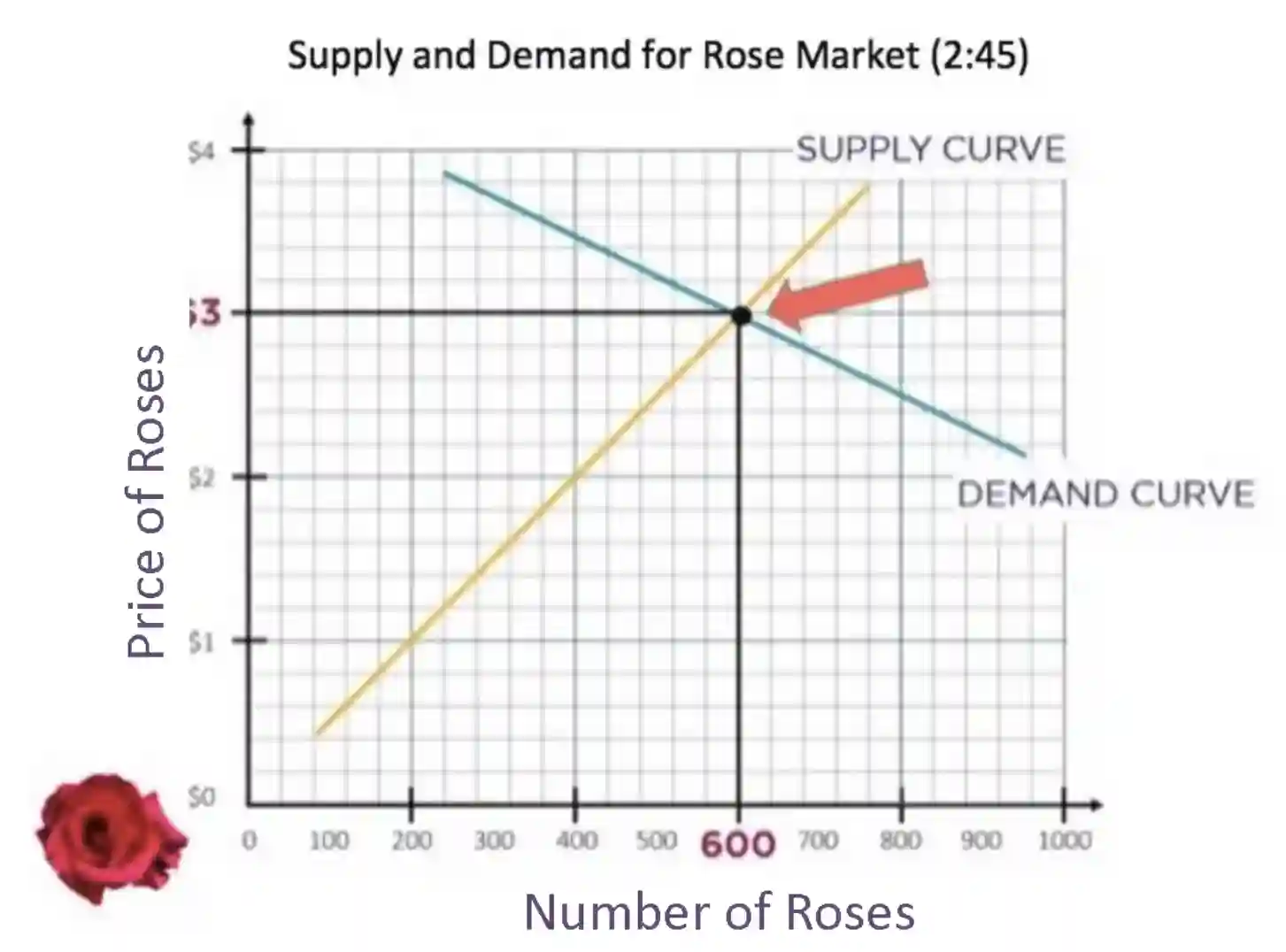
Intuition of Demand, Supply and Equilibrium
Here we have that the demand is : negative relation between price and quantity, the simple model says that as:
as price goes up, the demand of the quantity goes down
The demand is based on a person's preferences, and this can be some sort of derived.
The supply curve has equation , here we see a positive relationship. Solving the two meeting points we get: which is called the equilibrium point.
Clearly this is not true, because people's preferences get saturated, and you would not buy this ad infinitum, but this model is simple enough to get you the idea of this, so bear with the teacher!
We can use simple tools to explain much of the world ~Jonathan Gruber
The equilibrium is where the supply and demand curve meet. And both buyers and sellers are happy at that point. It seems to me that many models in economics are static, the same problem we are having in LLM benchmarks, and making them dynamic would be very very important. I also see this lecturer is very clear when explaining! Introducing one topic at the time, and getting right into the intuition of everything.
Positive and Normative Economics
Positive economics is the study of the way the things are.
For example, auctions, who values it more get's it, and who can give allocates it.
Normative economics is the study of the way the things should be.
For example in ebay auctions one kidney went to 5M$, the supply is low, the demand is high. Ebay shut it down saying no human parts auctions. But the normative answer is whether this is ok to sell it in such markets. We don't want this for market failures, we will see this later. First study (right wing science, the market knows best, you shoul dinterfer only when market is not working well) perfect market then the other cases. It helps you understand. Maybe this makes people forced to do it. The second reason it might be normatively prevented is for reasons of fairness, rich people living and poor people dying seems unfair. And America also has some notions of fairness. This topic will not be covered, and mostly cover efficiency and whether if the market will deliver. 14.41 in the courses.
Capitalist and Command Model
Different models of economics exist. We have a capitalist model and one command model. The capitalist model individuals decide what to produce and consume. This is purely free. This market never existed. But no market was purely capitalistic. The US is market-driven but government and socially-constrained. For example, we try to limit the kinds of harms, that it's possible to have. We have market within a set of rules by government and social-norms. In the invisible hand economy, you don't need the government to make the allocations, people coming together in a market should make the allocations, almost as magic. This model seems to work! But it leads to lots of inequality. The person that can pay the most get's the thing. In the other model, who get's it is who needs it the most. So leads to unfairness. America is one of the most unequal nations in the world. It's inevitable in the market that this will happen! Every economist agrees that a command economy does not work. So we need to understand how a government should intervene. Socialist means the government controls the industry and decides how much to produce. Most countries are forms of constrained capitalist economy. In EU it's more constrained and more equal.
The command model was the soviet model. And probably also by some forms China. Here, the government makes allocation, not people. There is no free transactions, the governments allocates both supply and demand. The right goods may get produced, and distributed fast. This goes back to Karl Marx. The government wants to produce the right thing and distribute it to the right people. In theory it works, in practice not. This is too hard to make in practice, this is the main argument, but perhaps with AI it's possible now, let's see. In East germany, nobody had cars, but everybody had too much bread, that was feeded to the dogs. When a charge of people are in command, probably they will make their lives better before the others, this seems human nature, which leads to corruption, this is the other argument against the command economy. In 1950s there was envy of the soviet nation from the US. So they were questioning the US model.
References
[1] Smith “The Wealth of Nations” Random House Publishing Group 1776